The Blessing of Fire
by Rev. Cav. William Rock, FSSP, SMOCSG
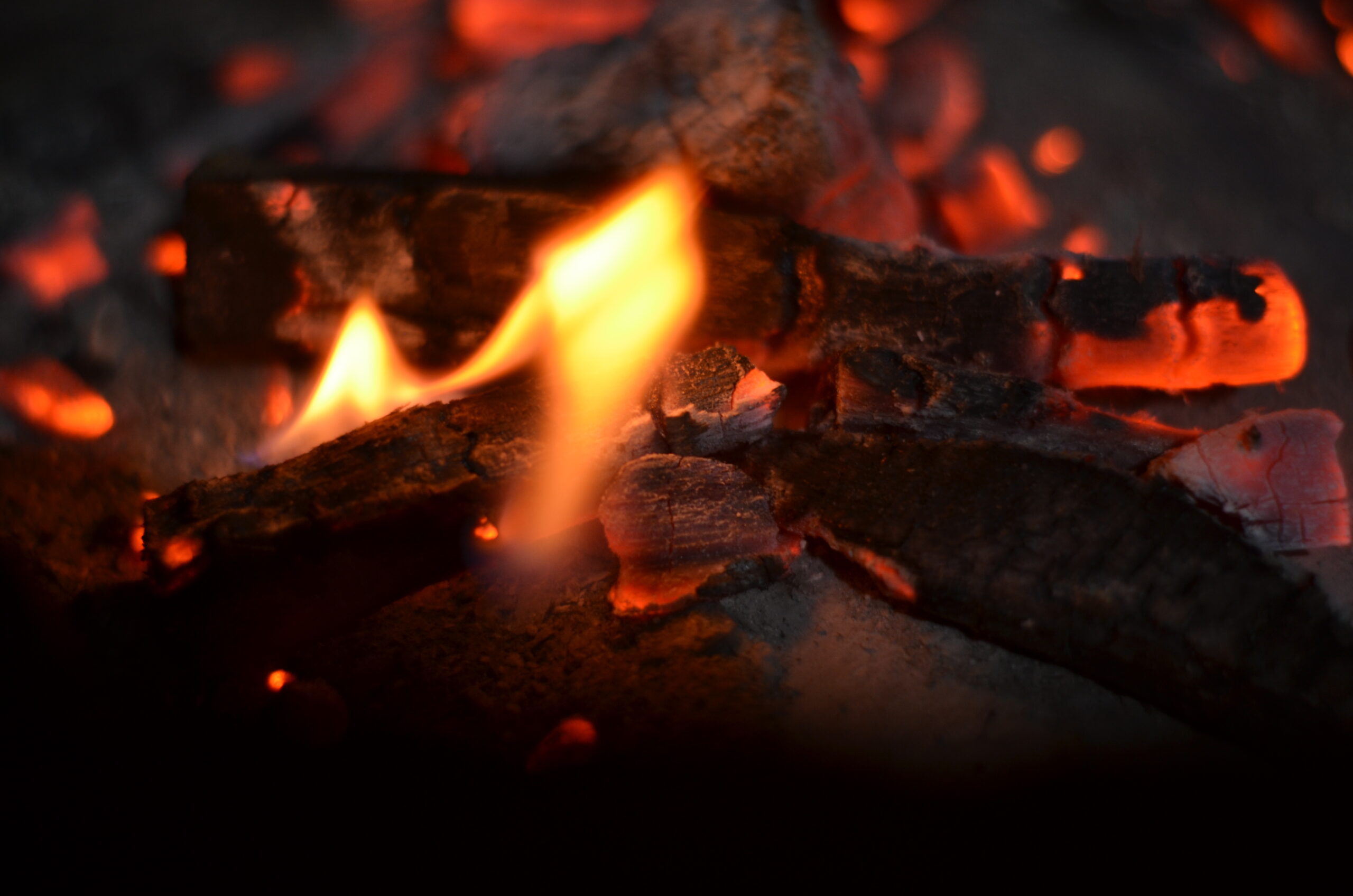
Many are no doubt familiar with the blessing of the New Fire at the Easter Vigil, and some are likely familiar with the blessing of a fire on the Vigil of the Nativity of St. John the Baptist, but, perhaps, only a few are familiar with the more generic blessing of a fire found in the Roman Ritual, a translation1 of which is here provided:
℣. Our help is in the name of the Lord.
℟. Who made heaven and earth.
℣. The Lord be with you.
℟. And with your spirit.Let us pray.
O Lord God, almighty Father, unfailing Light, You Who are the creator of all light: hallow + this new fire, and grant; that after the darkness of this world we may come with pure hearts to Thee, our unfailing Light; through Christ our Lord.
℟. Amen.
It is sprinkled with holy water.
The above formula is also found as part of the larger ceremony for the above-mentioned blessing of a bonfire on the Vigil of the Nativity of St. John the Baptist.2
What stands out in this blessing is that the main aspect of fire — which interestingly is not called “a creature” as is common in blessings of other natural items — referenced is the fire being a source of light. Its being a source of heat or its utility, such as in cooking, are not mentioned at all, although there can be seen a nod to fire’s role in purification. Both of these properties, that of being a source of light and of being an agent of purification, are reflected in God being the unfailing Light and creator of all light, including light from fires – indeed the very first creature named in the Genesis creation account is light (1:3) – as well as in the purification of heart which God works in and for His Faithful as they make their way in this world of darkness (hujus sæculi caliginem, a nod to the mundi tenebrarum harum of Eph 6:12).

Twice in the blessing, God is invoked as an “unfailing Light” (lumen indeficiens). This phrase is found in the twenty-fourth chapter, verse 6, of the Book of Ecclesiasticus (Sirach) where the wisdom figure is speaking. In the literal sense of interpretation, this passage is referring to Wisdom’s creation of material light, which will perdure even in the world to come, while there are several associated spiritual meanings, including the lumen indeficiens being the light given to the minds of the faithful by Jesus the Light (lux not lumen) and the lumen indeficiens being the Blessed Virgin Mary herself.3 In its original context, then, lumen indeficiens does not refer to God Himself. However, God Himself is referred to as being “light” in the First Letter of St. John where it is written: “God is light and in him there is no darkness” (1:5). Commenting on this passage, Cornelius à Lapide, summarizing the commentary tradition, has the following:
That God is light, and in Him is no darkness at all. The Word then is the light of men, by which they are enlightened through faith, hope, and charity. For it is spiritual light which is here spoken of. The meaning is, that our life consists in the enlightenment of the Word, whereby men are enlightened in the knowledge of God and their own salvation. And this was the reason why the Word was made flesh, and manifested to men. The Word then is substantial and uncreated light, formally, ideally, and as the cause of all light, whether corporeal or spiritual, of grace and of glory. God, accordingly, is said to be clothed with light (Ps. civ.), to be the Father of lights (James i. 17), and to dwell in unapproachable light (i Tim. vi. i6). For light is the noblest quality of matter, setting forth the glory and gifts of God’s illumination and grace. There are indeed very many and most beautiful resemblances between God and light. For the quality of light is its great swiftness and its efficacy, its purity, which is not soiled by anything it comes into contact with, bringing with it warmth, brightness, and gladness—making everything visible, giving to all living things life and vigour. Such is the grace of God. Sin is the opposite, and is therefore symbolised by darkness. S. Dionysius (Cœlest. Hier. cap. xv.) gives thirty-one resemblances between light and the grace of God. And S. John Damascene (de Fide ii. 11) compares the Holy Trinity to a parhelion, in which there appear to be three suns, though in reality there is but one. “He says the Godhead is indivisible, just as in these three suns, inseparably connected together, there is one and the same tempering and blending of light.” And Dionysius represents the Holy Trinity by three lamps, illuminating a house as with one single indistinguishable brightness. And the light of the Deity, and the Trinity, bright as it is in itself, yet is obscure darkness to us, because the eyes of our mind are unable to gaze steadily on so brilliant and over-powering a light. This is also referred to by Dionysius. The Father then is the source of light; the Son, light proceeding directly from Him with equal and commensurate brightness; the Holy Spirit, as a reflected brightness, proceeding from the mutual and reflected love of the Father and the Son. The Gentiles had some shadowy notion of this, Parmenides defining God as a continuous circle of light, encompassing heaven, and Democritus, as mind in a fiery circle.
Christ, as God and the Word, is the formal uncreated light; as man, He is the created light, because He is full of wisdom, grace, and glory. He is also the causal light, as being the cause of all grace and glory in us. As S. John says, “He is the light, because He enlightens every man that cometh into the world,” and that not as giving them the light of reason (as Origen and S. Cyril suppose), but rather as giving them the supernatural light of faith and wisdom. Malachi terms Him the Son of righteousness. Manichæus was wrong in supposing that the material sun was Christ (see S. Augustine, Tract. xxxiv. on S. John). Christ specially shone forth after His Incarnation, though He shone as a light even before that, as the dawn precedes the day. See S. Augustine (Tract. i. on S. John and Isa. xlx. 6). Christ said Himself, “I the Light of the World.” And Simeon also, Luke ii. 32. S. Augustine (Hom. xliii. inter 50 [nunc cxxxv]) says beautifully, “Christ came as an illuminator, because the devil had blinded men. This chiefest Physician compounded an eye-salve of infinite value to cure the blinded eyes. How healing was it, compounded of the Word and the flesh. But the eyes of man were so restored and enlightened, as to be equal to the eyes of angels, and to behold the heavenly glory of God Himself.” This light He imparted to the faithful, and especially to apostolic men, for them to become the light of the world (see Job xxxviii.; Ps. lxxxix.). And as He said to His apostles, “Ye are the light of the world.” So John, speaking of S. John the Baptist, and so S. Paul writes to the Ephesians, v. 5.
And in Him is no darkness at all, darkness being the type of ignorance and sin. So Didymus and Œcumenius, who quotes John i. 5, and adds, “He calls our sinful flesh darkness, in which Christ was born, and yet was not partaker of sin.” As Moses, David, Habakkuk, and S. James (i. 17) say of God. Our actions, however they shine, are not the light. But the Divine Essence is light. It was said of the holiest of men [St. John the Baptist] “He was not that Light;” but of the Word of God, it was said, “That was the true Light,” &c. And S. Gregory Nazianzen (Orat. xl.) says, “God is that highest and unapproachable Light, which cannot be conceived in the mind, or expressed in words, enlightening every nature which is endowed with reason, in matters intelligible to the mind, as the sun does in objects of sense, presenting itself more clearly to our comprehension, the more carefully we have cleansed our minds from sin, and as one who is the more greatly loved, the more we contemplate Him, and lastly, as one who is better known the more we love Him.”
All this indicates the truth of John’s words, that God is light perfectly unblended with darkness, and that light of the understanding, which enlightens the eyes of our soul to discern it, by withdrawing it from all material objects, exciting all our affections to desire it, and it alone.
This corresponds with John i. 4: “The light shineth in darkness, and the darkness comprehended it not.” Of which S. Gregory Nyssen (Orat. de Nativ.) remarks, “His purity touched our filthiness, but was not defiled.” And S. Augustine (Epist. ad Honorat) says, “The Son of God is not absent even from the minds of the ungodly, though they see Him not, just as light is not seen when presented to the eyes of the blind. But the light of the Word shines in the darkness of ungodly men, by the light of reason, by the voices of created beings, which exclaim that there is a Creator who is to be venerated and loved, by the law of nature within the mind, by the new law, by Scripture, by doctors and preachers, holy inspirations,” &c.
And hence S. Augustine (Tract. ii. in John) says, “Sink not into sin, and that sun will not sink to thee. If thou sinkest, He will sink to thee.”
The Gentiles seem to have seen this in a shadowy way. See S. Clement Alex., Strom. Lib. iv.
As the amount of daylight continues to grow shorter as we approach the winter solstice, may these reflections on the blessing of fire give us confidence that God, the unfailing Light, will continue to illuminate our minds and hearts so long as we remain close to Him. And if you, dear reader, ever have the opportunity to enkindle a fire with a priest present, see if you can arrange for him to bless it.
Rev. Cav. William Rock, FSSP, SMOCSG was ordained in the fall of 2019 and was invested as an Ecclesiastical Knight of the Sacred Military Constantinian Order of St. George in the summer of 2025. He currently resides at the FSSP Canonical House of St. Casimir in Nashua, NH, and ministers at St. Stanislaus parish.
In support of the causes of Blessed Maria Cristina, Queen, and Servant of God Francesco II, King

- Rituale Romanum [1957], Titulus IX – Caput 8, 10; English adapted from the Weller translation provided online by EWTN (2, VIII, 12).
- Rituale Romanum [1957], Titulus IX – Caput 3, 13.
- à Lapide, Cornelius. The Great Commentary on the passage under discussion.
November 17, 2025






FSSP 2026 Calendar