The Eyes of Our Mind
by Rev. Cav. William Rock, FSSP, SMOCSG

The Preface of the Nativity, used during the Twelve Days of Christmas, on the Feast of the Presentation (2 February, Candlemas), as well as traditionally on the Feasts of Corpus Christi (and its Octave) and of the Transfiguration (6 August),1 reads as follows:
It is truly meet and just, right and for our salvation, that we should at all times, and in all places, give thanks unto Thee, O holy Lord, Father almighty, everlasting God, for through the Mystery of the Word made flesh, the new light of Thy glory hath shone upon the eyes of our mind (mentis nostræ óculis), so that while we acknowledge God in visible form, we may through Him be drawn to the love of things invisible. And therefore with Angels and Archangels, with Throne and Dominations, and with all the hosts of the heavenly army, we sing the hymn of Thy glory, evermore saying: Holy…
Within this text is the curious phrase “eyes of the mind.” An equivalent phrase is also found the Third Oration used in the Blessing of Candles on Candlemas, the final day of the Christmas Season understood in its widest sense: “that the eye of our mind being cleansed / ut, purgáto mentis óculo.” Being aware of all this, the questions can naturally arise, what is meant by the phrase “eye(s) of the mind?” and from whence does it come? As it turns out, this phrase, “eye” or “eyes of the mind,” has a very ancient pedigree.
The ecclesiastical writer Origen (d. ~ A.D. 253) in his work Against Celsus (VII, 39), notes that the distinction between “the eye of the body and the eye of the mind,” is “borrowed from the Greeks,” that is from Greek philosophers, but he does not name which ones. An equivalent phrase, “the eye of the soul /το ομμα της ψυχης,” however, is found in the Republic (Book 7, 533.d) of Plato (d. 348/347 B.C.). The phrase “eye(s) of the mind / ocul–us, –i mentis,” or its equivalent, can be found in the works of Christian writers such as:
- St. Paul (d. A.D. ~65) used the phrase “the eyes of your heart / oculos cordis vestri / τους οφθαλμους της καρδιας υμων” in Ephesians 1:18
- St. Irenaeus of Lyon (d. A.D. ~202), Against Heresies, IV, 39, 1
- St. Hilary (d. A.D. ~367), Commentary on Matthew, Chapter 9
- St. Cyril of Jerusalem (d. A.D 368), Catechetical Lectures, Prologue, 15
- St. John Chrysostom (d. A.D. 407), Homily 7 on First Corinthians, 2
- St. Jerome (d. A.D. 420), On Isaiah, ch. 6
- St. Augustine (d. A.D. 430), passim2 (e.g. On the Trinity, XI, 3)
- St. John Cassian (d. A.D. ~435), De Inst. Coenob. viii, 6, uses the equivalent phrase “oculum cordis”
- St. Gregory the Great (d. A.D. 604), Moral. v, 45, Hom. xiv in Ezech.
- St. Isidore of Seville (d. A.D. 636), Etym. vii, 8 where he uses “intuitum mentis” and posits the soul’s imagination as another eye
- The Venerable Bede (d. A.D. 735), as quoted in the Catena Aurea, Luke, Chapter 9 where he uses “mentis aciem“
- St. Thomas Aquinas (d. A.D. 1274), e.g. Commentary on the Sentences, II, d. 22, q. 1, a. 1, ad. 1; Commentary on the Sentences, IV, d. 4 , q. 2, a. 2, r. 3
This list suffices to demonstrate the pedigree of the phrase “eye(s) of the mind,” or its equivalent, in both the East and the West. But the question still remains, what does it mean?
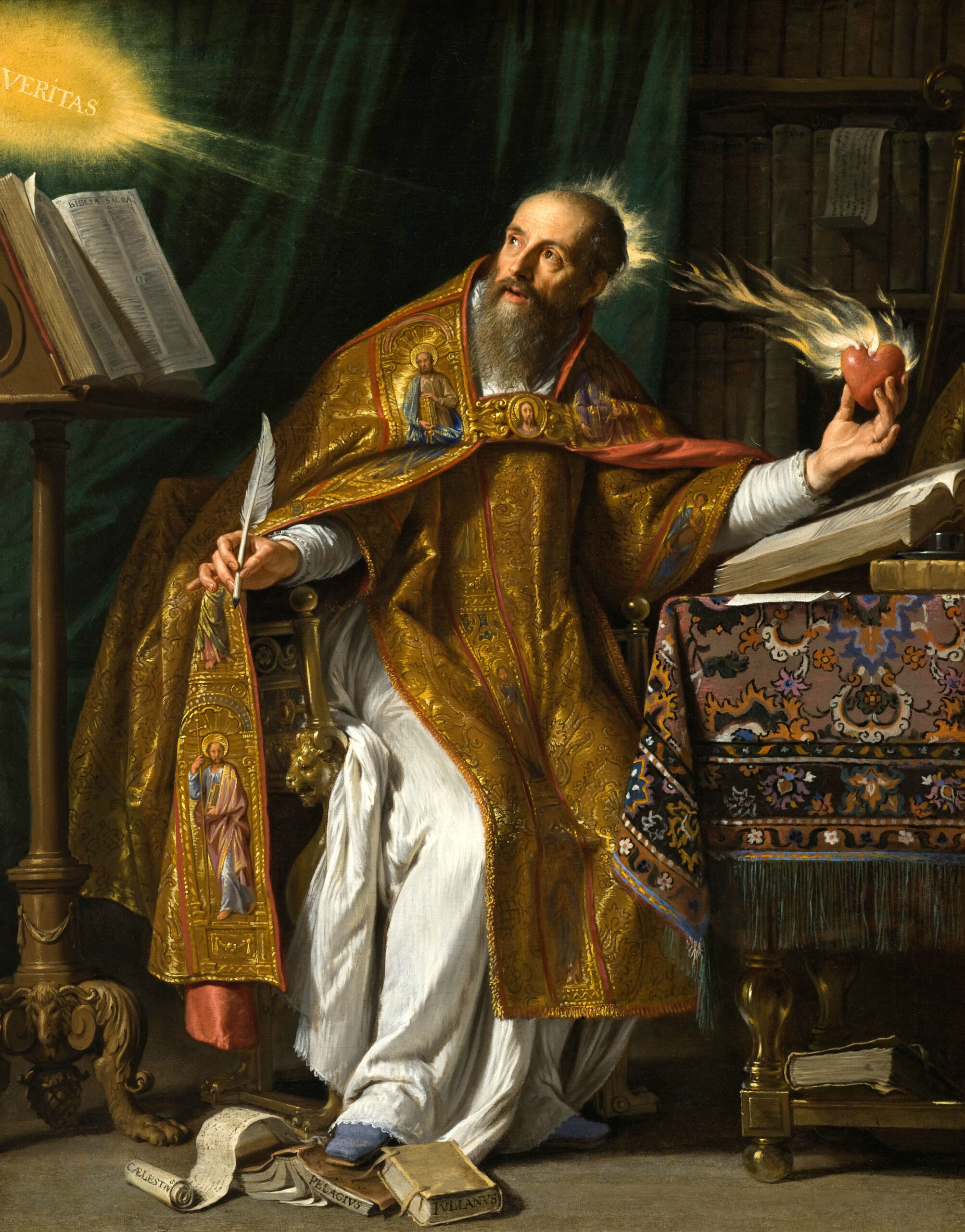
To answer this question, we turn to St. Augustine who made great use of this phrase. According to St. Augustine, the three highest powers of the soul are the intellect, will, and memory (see De Trin. x, 11, 17) and he identifies the “eye of the mind” with the particular power of the soul which views things (see De Trin. x, 3, 6). For Augustine, the memory presents that which is viewed by the “eye of the mind,” so the memory is distinct from the “eye of the mind.” Additionally, the will, which the Saint marks as distinct from the “eye of the mind,” does not view but rather chooses and loves. So, the “eye of the mind” cannot be the will. This leaves intellect.
So, by “eye of the mind,” one should understand the intellect, the highest power of the soul. But not just the intellect in general, nor the intellect when it undertakes discursive reasoning nor when making profound judgments, but specifically the intellect when it is contemplating, studying, identifying what is placed before its gaze. This corresponds with what St. Thomas wrote about intellectual vision (e.g. S.T. I, q. 12, a. 2, c) where the intellect is, in a sense, a “power of sight” illuminated by the natural “light” of reason and/or by supernatural “light.” Additionally, the “eyes of the mind” must be strengthened, or augmented, to be able to “see” connaturally by supernatural “light.” This augmentation is brought about by the sacrament of Baptism for, as St. Thomas wrote in his Commentary on the Sentences (cited above),
Baptism leads to external and interior spiritual vision: interior, inasmuch as Baptism is called the sacrament of faith, which makes the eye of the mind suited to seeing divine things; and external, because it is granted to the baptized and not to others to gaze upon the sacred Eucharist, as Dionysius says; and thus both Damascene and Dionysius attribute illuminative force to Baptism.
In the thought of St. Thomas, then, it is the Virtue of Faith, which is infused at Baptism and resides in the intellect (S.T. II-II, q. 4., a. 2), which augments the “eyes of the mind” to be able to “see” connaturally by supernatural “light” in this life. The supernatural “light” needed to “see” actually in a particular instance would be the “light” granted by actual grace.

Now, as the intellect is an immaterial, or spiritual, power, the “eye of the mind” is able to perceive deeper realities than the “eyes of the body,” which are limited by being material, even on the natural level. This penetration, however, is limited by the “lights” by which the “eyes of the soul” “see” and by the conditions of the “eyes of the mind” themselves. Thus, for example, while the “eyes of the body” may only see/perceive the accidents of bread when gazing on the consecrated Eucharistic Host, the “eye of the mind,” augmented by the virtue of Faith and enlightened by actual grace, “sees”/perceives/discerns the Body of Christ.
But, just as the ability of the “eye of the mind” to perceive deeper realities can be augmented/strengthened, it can also be weakened or obscured. In his work referenced above, St. Gregory wrote that “anger which comes of evil blinds the eye of the mind,” indicating that strong passions/emotions can obscure the intellect’s vision. The same can be said of sin and vice as one of the effects of sin is a blindness or a darkening of the intellect, which makes it difficult to “see” things properly (see S.T. I-II, q. 85). St. Thomas, for example, notes that by pride “the eye of the mind was impeded from actually attending to the truth of what God said [to Adam].” The removal of sin and vice allows the “eye of the mind” “to see” things more clearly in general, hence the phrase quoted earlier from the Third Oration in the Candlemas Blessing of Candles – “Blessed are the clean of heart: they shall see God” (Mat 5:8). Additionally, controlling the passions/emotions in situations when they are being greatly agitated allows for a clearer “vision” in a particular situation.
With this understanding, the Preface of the Nativity, when used during the Christmas season, can be understood in this way: The “eyes of the body” see only what is materially before them which, in the case of the newborn Christ (“God in visible form”), would only be His material Body, His Humanity. The “eyes of the mind” (the intellect), already augmented by the Faith received in Baptism, however, having received a new, supernatural “light,” that is actual grace, due to the Church’s celebration of the Lord’s Nativity, are able to perceive deeper things in “seeing” the same subject, namely “things invisible,” such as Our Lord’s Divinity.
As we continue through this year’s Christmastide, and in Christmastides of the future, may these reflections give us a deeper appreciation and a deeper understand of this curious Preface of the Nativity.
Rev. Cav. William Rock, FSSP, SMOCSG was ordained in the fall of 2019 and was invested as an Ecclesiastical Knight of the Sacred Military Constantinian Order of St. George in the summer of 2025. He currently resides at the FSSP Canonical House of St. Casimir in Nashua, NH, and ministers at St. Stanislaus parish.
In support of the causes of Blessed Maria Cristina, Queen, and Servant of God Francesco II, King

- In the 1962 Missal, the Common Preface is indicated for the Feasts of Corpus Christi and of the Transfiguration. However, the 2021 CDF Ordo Divini Officii Recitandi Sacrique Peragendi allows the preface of the Nativity to be used on the Feast of Corpus Christi (p. 109) and on the Feast of the Transfiguration (p. 134) restoring the older practice. The Octave of Corpus Christi was removed from common observance under Pope Pius XII, but the same Ordo allows for exercises of piety to be continued during the days of the former Octave where there is the custom of so doing (“Peculiaria pietatis exercitia, quae cum populi concursu, diebus olim intra octavam Ss.mi Corporis Christi, ex traditione, celebrari consueverunt, continuari possunt“) (p. 109).
- In his post Upward and Inward: Augustine and Suso on Finding God Beyond and Within, Dr. Jason Baxter identified that in his Confessions, St. Augustine used the following phrases: “oculus animae /eye of the soul” (VII.10.16; VII.16.6), “acies mentis / eye of the mind” (VI.4.6; VII.1.1; VII.3.5), “interior oculus / interior eye” (XII.20.29).
January 2, 2026






FSSP 2026 Calendar