(This is part of a series of articles, and will make little sense without the previous installments (1) , (2), (3) , and (4)
Aside from Yom Kippur and the Fast of Gedaliah, there are three other fast days in the Hebrew calendar, all relating to the destruction of the first temple. Yom Kippur (10 Tishri) is the primordial day of fast, going all the way back to the Exodus. (Lev 23:26-32) It is interesting that it stands as the fall equivalent of the day of the selection of the lamb for Passover (10 Nisan), and that it is the only day of fast that is also a day of rest (work is forbidden) according to the Torah. However, it is not one of the four fasts mentioned in Zechariah: “Thus says the Lord of hosts: The fast of the fourth month, and the fast of the fifth, and the fast of the seventh, and the fast of the tenth, shall be to the house of Judah seasons of joy and gladness, and cheerful feasts; therefore love truth and peace.” (Zech 8:19)
The four fasts mentioned here are those of Gedaliah (previously mentioned [2]), that of 10 Tevet, 17 Tammuz, and 9 Av. The fast of the Day of Atonement is not included among these days.
The fast of 10 Tevet, assuming that we imagine in our idealized calendar that there are always 6 Sundays after Epiphany, and 24 Sundays after Pentecost, would fall on the Tuesday after the second Sunday after Epiphany, if we count backwards from Easter Sunday (yes, we can go backwards too, just not as far). Of course, there are not always 6 Sundays after Epiphany, nor are there always exactly 24 Sundays after Pentecost, but the puzzle pieces don’t fit together unless we use this precise number in our analysis. The unneeded Sundays after Epiphany in the schema are simply deleted, as they have the same Mass propers and repeat a similar theme, and the Sundays after Pentecost “grow” (cf. the parable of the mustard seed, the 6th and final Sunday after Epiphany, which, along with any others needed, is inserted in the gap between the 23rd and 24th Sunday after Pentecost, in a sense “growing” that period of time).
In fact, the only interesting events (from the standpoint of the Hebrew calendar) within the 6 Sundays after Epiphany fall in those first two weeks, and 10 Tevet in our arrangement lands on the Tuesday after the second Sunday after Epiphany. This Sunday completes the observance of Epiphany, commemorating the Wedding at Cana. During this week, an interesting event happens in our lunar calendar model, namely, the siege of Jerusalem began in approximately 587 BC. “In the ninth year, in the tenth month, on the tenth day of the month, the word of the Lord came to me: Son of man, write down the name of this day, this very day. The king of Babylon has laid siege to Jerusalem this very day.” (Ezek 24:1-2) This seems like a fairly strong endorsement for remembering this day.
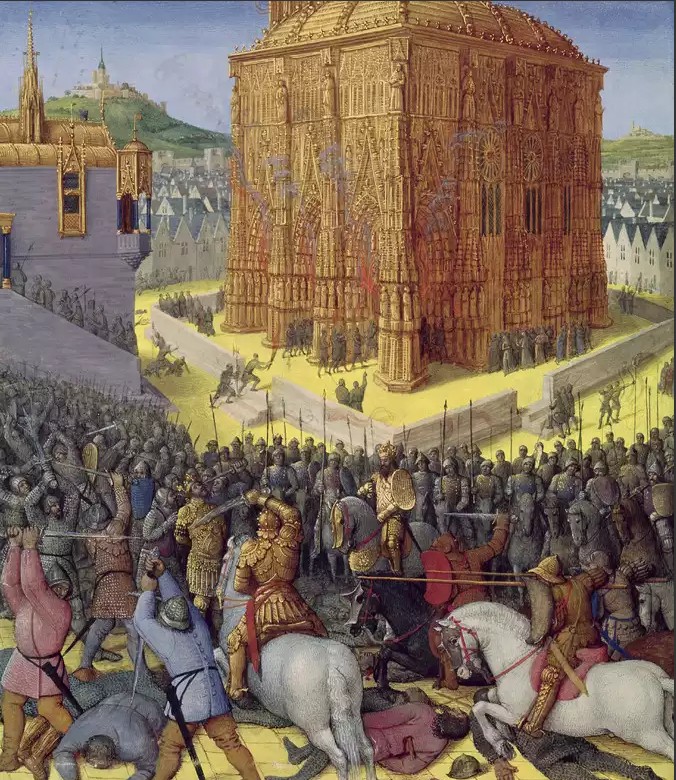
This siege would ultimately result in the destruction of the temple and most of the city, including the walls:
In the fifth month, on the tenth day of the month—which was the nineteenth year of King Nebuchadrezzar, king of Babylon—Nebuzaradan the captain of the bodyguard who served the king of Babylon, entered Jerusalem. And he burned the house of the Lord, and the king’s house and all the houses of Jerusalem; every great house he burned down. And all the army of the Chaldeans, who were with the captain of the guard, broke down all the walls round about Jerusalem. (Jer 52:12-14)
The account given elsewhere differs in detail but not in substance: “In the fifth month, on the seventh day of the month,” etc… (2 Kgs 25:8)1
Ezekiel continues:
Therefore thus says the Lord God: Woe to the bloody city! I also will make the pile great. Heap on the logs, kindle the fire, boil well the flesh, and empty out the broth, and let the bones be burned up. Then set it empty upon the coals, that it may become hot, and its copper may burn, that its filthiness may be melted in it, its rust consumed. In vain I have wearied myself; its thick rust does not go out of it by fire. Its rust is your filthy lewdness. Because I would have cleansed you and you were not cleansed from your filthiness, you shall not be cleansed any more till I have satisfied my fury upon you. I the Lord have spoken; it shall come to pass, I will do it; I will not go back, I will not spare, I will not repent; according to your ways and your doings I will judge you, says the Lord God.” (Ezek 24:9-14)
Clearly a judgment by fire is coming. Now let us look at the matins reading assigned for this random weekday, the Tuesday after the Second Sunday after Epiphany, or as the Byzantines might say more concisely, the third Tuesday after Epiphany:
Prise de Jérusalem par Nabuchodonosor, Jean Fouquet, 1470
“For we know that if the earthly tent we live in is destroyed, we have a building from God, a house not made with hands, eternal in the heavens. Here indeed we groan, and long to put on our heavenly dwelling, so that by putting it on we may not be found naked. For while we are still in this tent, we sigh with anxiety; not that we would be unclothed, but that we would be further clothed, so that what is mortal may be swallowed up by life. He who has prepared us for this very thing is God, who has given us the Spirit as a guarantee. So we are always of good courage; we know that while we are at home in the body we are away from the Lord, for we walk by faith, not by sight. We are of good courage, and we would rather be away from the body and at home with the Lord. So whether we are at home or away, we make it our aim to please him. For we must all appear before the judgment seat of Christ, so that each one may receive good or evil, according to what he has done in the body.” (2 Cor 5:1-10)2
The idea of wishing to save their earthly habitation at any cost would be revisited by the high priests later, before conspiring to put our Lord to death. “So the chief priests and the Pharisees gathered the council, and said, “What are we to do? For this man performs many signs. If we let him go on like this, every one will believe in him, and the Romans will come and destroy both our holy place and our nation.” (Jn 11:47-48)
They did not realize that the “earthly habitation,” i.e. their holy city, their temple observances, their observance of the Feast of Tabernacles, was a symbol of the weakened and corrupt flesh in which we now dwell, waiting to be reformed in Christ: “But our commonwealth is in heaven, and from it we await a Savior, the Lord Jesus Christ, who will change our lowly body to be like his glorious body, by the power which enables him even to subject all things to himself.” (Phil 3:20-21)
The next two fast days fall in the summer months, within 3 weeks of each other, and we will look at those next time. We have already seen hints of them in the scriptural passages quoted in this article.
1 “Rabbinic tradition explained away the discrepancies by viewing the varying dates as the beginning and end points of the destruction; . . . The day of national mourning was set on the ninth of Ab; cf. Josephus, Antiquities x.135.” — Mordechai Cogan and Hayim Tadmor, II Kings: A New Translation with Introduction and Commentary, vol. 11, Anchor Yale Bible (New Haven; London: Yale University Press, 2008), 318.
2 While it might seem overly aggresive to start making connections with matins readings for certain days, the readings as they are arranged in our Divine Office have a great deal of antiquity behind them, perhaps more than is commonly admitted: “The distribution of Holy Scripture for the lessons of the first nocturn was made conformably to the decree commonly called that of Gregory VII—in reality, as regards its main outlines, it agrees with the ancient distribution, the use of which in the eighth century we have already verified. Every day had its lesson from Scripture, and these were chosen, with few exceptions, from the plainest and simplest pages of the Bible.” (Pierre Battifol, History of the Roman Breviary, trans. Atwell M. Y. Baylay [London: Longmans, Green / Co., 1912], 204) Regardless, this is not meant to be a rigorous study, just a very long “what if” scenario.