The Other Tenth Month (Lunar)
by Fr. Mark Wojdelski, FSSP
(This is part of a series of articles, and will make little sense without the introductory articles: (1) , (2), (3), and (4). There are more than four articles in the series, but the first four are very important to understanding the conceptual framework.)
The tenth month of the lunar calendar, called Tevet, generally corresponds to the time from the end of December to the beginning of January in the Gregorian solar calendar.
It might seem strange to go through the calendar slowly like this, when nothing particularly interesting is going on. The idea is not to approach this project as liturgical scholarship strictly speaking, but rather as a kind of art appreciation. The alternative would be to fall back on a sterile historico-critical analysis of the liturgy based on the supposition that it, like everything else in our very advanced and enlightened society, can be fully and completely explained in its present form by a process of mistakes and historical processes of generation and corruption guided by some sort of “evolution.” Whether such supposed “evolution” was guided by God or not seems irrelevant to such scholarship, although scholars professing the faith would presumably not dare to suggest that the process was random, or that a certain type of popular piety at some early stage in the life of the church that became incorporated into the liturgy before detailed records were being kept was somehow a mistake. If we look at the liturgy as something that we have received, as opposed to something that is the work of particular men living at particular times in history, whose names are known, such considerations become irrelevant. Even a masterwork of art has parts that are not particularly spectacular, but are part of the whole and worthy of consideration. The liturgy makes our Lord present to us every day in much the same way that He was given to us the first time: “Yet we know where this man comes from; but when the Christ appears, no one will know where he comes from.” (Jn 7:27)
We’ve already looked at the fast observed on the tenth day of Tevet, the tenth month of the lunar calendar, and the first month of winter. (here) By way of reminder, recall that this day commemorates the beginning of the siege of Jerusalem before the destruction of the first temple. (Ezek 24:1-2) But there were a few other things that scripture records as having happened in those first two weeks of the month. I’ve previously explained why those weeks, corresponding to the first and second Sundays after Epiphany, are the only weeks that matter for our purposes.
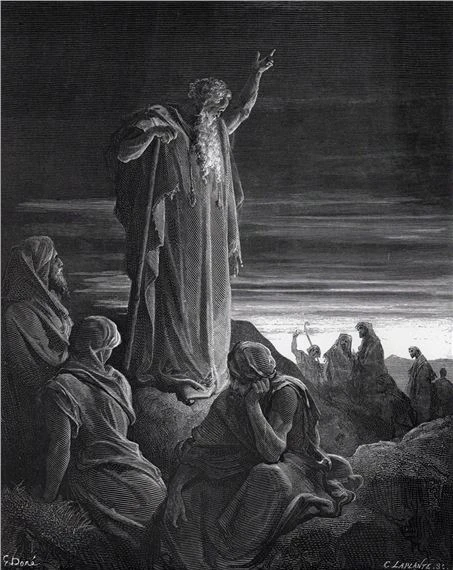
First of all, on that same day, the 10th of Tevet, this happens to Ezekiel:
Also the word of the Lord came to me: “Son of man, behold, I am about to take the delight of your eyes away from you at a stroke; yet you shall not mourn or weep nor shall your tears run down. Sigh, but not aloud; make no mourning for the dead. Bind on your turban, and put your shoes on your feet; do not cover your lips, nor eat the bread of mourners.” So I spoke to the people in the morning, and at evening my wife died. And on the next morning I did as I was commanded.
And the people said to me, “Will you not tell us what these things mean for us, that you are acting thus?” Then I said to them, “The word of the Lord came to me: “Say to the house of Israel, Thus says the Lord God: Behold, I will profane my sanctuary, the pride of your power, the delight of your eyes, and the desire of your soul; and your sons and your daughters whom you left behind shall fall by the sword. And you shall do as I have done; you shall not cover your lips, nor eat the bread of mourners. Your turbans shall be on your heads and your shoes on your feet; you shall not mourn or weep, but you shall pine away in your iniquities and groan to one another. Thus shall Ezekiel be to you a sign; according to all that he has done you shall do. When this comes, then you will know that I am the Lord God.” (Ezek 24:15-24)
The siege of Jerusalem was announced to Ezekiel by almighty God on this day, and on that very evening, going into the following day (11 Tevet), he was to lose his wife. Moreover, he was told not to perform any outward mourning. This would have been very unusual for an observant Jew, who typically observed an entire month of mourning, beginning with with a period of seven days of intense mourning.
Perhaps we can find some connection with the end of the matins reading assigned for today, the Wednesday after the Second Sunday after Epiphany: “For godly grief produces a repentance that leads to salvation and brings no regret, but worldly grief produces death.” (2 Cor 7:10) Grief is not a bad thing, St. Paul explains, if it leads to humility and repentance. Ezekiel is not told that he should not be sad on the inside, but he is instructed not to do anything outwardly to manifest those feelings.
Although Ezekiel received word of the beginning of the siege of Jerusalem in a vision from God, he did not receive word of its destruction until three years later, but in the same month:
In the twelfth year of our exile, in the tenth month, on the fifth day of the month, a man who had escaped from Jerusalem came to me and said, “The city has fallen.” Now the hand of the Lord had been upon me the evening before the fugitive came; and he had opened my mouth by the time the man came to me in the morning; so my mouth was opened, and I was no longer mute. (Ezek 33:21–22)
The matins reading assigned for this day, the Thursday of the first week after Epiphany, is an interesting one, because it seems to be absent from the regular course of readings in the modern liturgy.
Now concerning the matters about which you wrote. It is well for a man not to touch a woman. But because of the temptation to immorality, each man should have his own wife and each woman her own husband. The husband should give to his wife her conjugal rights, and likewise the wife to her husband. For the wife does not rule over her own body, but the husband does; likewise the husband does not rule over his own body, but the wife does. Do not refuse one another except perhaps by agreement for a season, that you may devote yourselves to prayer; but then come together again, lest Satan tempt you through lack of self-control. I say this by way of concession, not of command. I wish that all were as I myself am. But each has his own special gift from God, one of one kind and one of another. To the unmarried and the widows I say that it is well for them to remain single as I do. But if they cannot exercise self-control, they should marry. For it is better to marry than to be aflame with passion. (1 Cor 7:1–9)
Mutual rights of spouses over each other’s bodies, the preferability of continence even within marriage, and the superiority of the celibate state over the married state are rather fundamental postulates of Christianity, ideas that have sadly been under increasing attack, implicitly and explicitly, even by some inside the church. A church that attempts to overcome the unbelieving nations surrounding it by strength of numbers or any other material advantage (rather than trying to convert those people) is fighting a losing battle, putting its faith in the strength of men. (“It is better to take refuge in the LORD than to put confidence in man.” [Ps 117:8] and “Cursed is the man who trusts in man and makes flesh his arm, whose heart turns away from the LORD.” [Jer 17:5])
This might seem to have nothing to do with this day, but see what else Ezekiel says later that day, the 11th of Tevet:
Then they will know that I am the Lord, when I have made the land a desolation and a waste because of all their abominations which they have committed.
“As for you, son of man, your people who talk together about you by the walls and at the doors of the houses, say to one another, each to his brother, ‘Come, and hear what the word is that comes forth from the Lord.’ And they come to you as people come, and they sit before you as my people, and they hear what you say but they will not do it; for with their lips they show much love, but their heart is set on their gain. And behold, you are to them like one who sings love songs with a beautiful voice and plays well on an instrument, for they hear what you say, but they will not do it. When this comes—and come it will!—then they will know that a prophet has been among them.” (Ezek 33:29–33)
Three years ago, we saw Ezekiel being told not to mourn for his deceased wife, and today God speaks through him again, upbraiding the Jews for their covetousness and worldliness, and pointing ahead to the word of God spoken through St. Paul:
I mean, brethren, the appointed time has grown very short; from now on, let those who have wives live as though they had none, and those who mourn as though they were not mourning, and those who rejoice as though they were not rejoicing, and those who buy as though they had no goods, and those who deal with the world as though they had no dealings with it. For the form of this world is passing away. (1 Cor 7:29-31)
The message of Ezekiel is very similar to what our Lord said (quoting Isaiah) to those gathered to listen to Him: “This people honors me with their lips, but their heart is far from me.” (Mk 7:6) Rather than allow themselves to be led by the Holy Spirit, many would rather prefer to see how hard they might push against Him without sinning.
One final event needs to be examined in this month, which took place on 8 Tevet, corresponding to the Second Sunday after Epiphany. On that day, according to an old Jewish tradition, the Septuagint translation was ordered to be prepared, supposedly at the request of King Ptolemy II of Egypt. The Septuagint (or LXX) is the translation of the Hebrew scriptures into Greek made by Jews in the diaspora. The Jews see this as a sad day; we can rather see it as something positive, as it allowed the Old Testament to be read by many very wise people who could not read Hebrew. This may have even been the means by which the wise men, well versed in the knowledge of many different religions and philosophies, knew to go to Jerusalem to consult the priests regarding the birth of the Messiah, to see if perhaps they were misreading their texts due to translation issues. The translators of the Septuagint also made a number of exegetical decisions that influenced how the scriptures would be interpreted even in the first century A.D., and Greek speakers, like St. Paul, freely used the Septuagint version directly in their writing and preaching rather than interpret the original text for their audience. It is then perhaps interesting that this day falls during the time in the cycle of the scriptural readings of the Divine Office when all the epistles of St. Paul, the apostle to the gentiles, are read at matins, starting at Christmas and ending the day before Septuagesima.
January 7, 2026







FSSP 2026 Calendar