The Parables of Christ, Part II: Their Historical Truth and Accuracy
 by Father James Buckley, FSSP
From the January 2011 Fraternity Newsletter
In Mark 4:11–12 (and in the parallel passages from Matthew 13:13 and Luke 8:10) Christ says that the apostles “are given to know the mystery of the kingdom of God” but that others are told this truth in parables so that “hearing they may hear and not understand.” From these words the question arises about Christ’s intention in using parables.
Writing in 1926, the Dominican Fr. James Voste, a professor of New Testament exegesis at the Angelicum, observed that many non-Catholic commentators repudiated this question. According to them, the difficulties and obscurities recorded in the parables are the invention of the evangelists and not what Christ Himself actually said. They claim that the evangelists imposed a difficult and enigmatic form on the parables of Our Lord to provide a reason to the early Christians for Israel’s blindness and exclusion from the kingdom of God.
Even to this day several well-respected and influential non-Catholic exegetes maintain that the parables which appear in the Gospels are different from the parables originally given by Our Lord. C.H. Dodd, for example, commenting on Mark 4:11–20, writes: “These facts create at once a presumption that we have here not a part of the primitive tradition of the words of Jesus, but a piece of apostolic teaching.” (Parables of the Kingdom, p.4) The highly regarded Joachim Jeremias writes: “Already in the earliest period of all, during the first decade after the death of Jesus, the parables had undergone a certain amount of reinterpretation…” (The Parables of Jesus, p. 12)
This explanation, which denies the authentic history of the parables, was identified and condemned by Lamentabile. (“The Evangelists themselves as well as Christians of the second and third generation artificially arranged the parables and so they gave a reason for the small fruit of Christ’s preaching among the Jews.”)
But even among Catholic exegetes who accept the historical authenticity of the New Testament parables, there is a difference of opinion regarding the meaning of Christ’s saying that He used parables so that “seeing they see not, and hearing they hear not, neither do they understand.”
In his commentary on St. Matthew’s Gospel, the outstanding biblical scholar, Fr. Cornelius de Lapide, S.J. wrote: “Christ spoke in parables, with this intention and this end in view; that He might instill into them (the scribes and Pharisees) a sincere desire of examining their meaning, believing in Christ and being saved, and that having suffered a temporary blindness with regard to the parables which they did not comprehend, they might the more eagerly desire Christ, the true light, and ask of Him the explanation of the parables” (The Holy Gospel According to Saint Matthew, Volume II, p. 10).
This appears to be the majority opinion, but there is a minority opinion which is well argued by another Jesuit scholar, Fr. Leopold Fonck, S.J. Father Fonck, first of all, acknowledges that not all the parables needed an explanation and maintains that among Our Lord’s hearers there were many who were not adverse to further instruction. These, when they could not penetrate the meaning of the parables of the kingdom, he says, would seek an explanation from the disciples. The scribes and Pharisees, whose militant disbelief in Christ and in His miracles erupted in the blasphemous accusation that He was possessed (Mt. 12:24), were a different case. By their actions “they had brought upon themselves the sentence of reprobation” so now “they had to experience the punishment of their hard-heartedness.” These men would hear but not understand and their unbending pride would prevent their enlightenment. Since a Catholic is free to accept either de Lapide’s or Fonck’s position, I will next month explain one of the clues for understanding the meaning of some parables.
January 5, 2011

Panoramic View of Dayton, Ohio Apostolate
The Fraternity apostolate in Dayton, OH has unveiled a panoramic view of its historic and beautiful church. Built in 1926 in the Romanesque style, the church was left unscarred by the iconoclast spirit so prevalent in the second half of the twentieth century.

View the panoramic tour at Holy Family Church in Dayton, OH.
Visit the the Holy Family Church FSSP Apostolate website.
Holy Family Parish Information:
Fr. Mark Wojdelski, FSSP, Pastor
Fr. Joseph Orlowski, FSSP, Parochial Vicar
Office and residence:
140 S. Findlay St.
Dayton, OH 45403
tel (937) 938-6098
Holy Family Catholic Church
5th Street & Findlay; Dayton OH
Mass Schedule:
Sunday 8:00 & 10:30 a.m.
Monday-Friday 7:15 a.m.
Saturday 9:00 a.m.
Holy days 7:00 a.m., 7:00 p.m.
December 14, 2010
Painting of Our Lady of Guadalupe Installed at OLGS
Recently, an incredibly beautiful painting of Our Lady of Guadalupe was installed in the new chapel at the seminary in Denton, Nebraska.


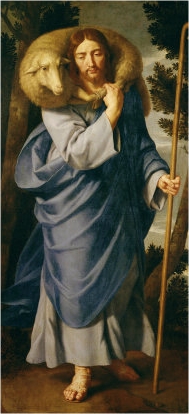
The Parables of Christ: a Discussion of Fr. James Buckley, FSSP
 by Fr. James B. Buckley, FSSP
From the December 2010 Newsletter
When I was in the fifth grade at St. Luke’s in the South Bronx, Sister Vincentia one morning darkened all the classroom windows and turned off the electric lights. Standing in front of us, she held an orange in her left hand and a flashlight in her right. She shined the flashlight on the orange so that all of us could see that the upper part was in light and the lower part in darkness. She rotated the orange and what had been in light was now in darkness and what had been in darkness was now in light. By showing us the relationship between an orange and a lighted flashlight in a darkened room—something we could see—she taught us about something we could not see, i.e. the relationship between the sun and our planet earth.
In making known supernatural truths Christ also taught His audiences by comparisons with familiar things and He did this through parables. Parables belong to the literary category of a simile and not that of an allegory. In an allegory every detail of the literary figure corresponds to something outside of it. Saint Paul, for example, in his letter to the Ephesians uses allegory in describing the armor of the Christian in his fight against iniquity. He admonishes him to put on the “breastplate of justice,” take up “the shield of faith,” and wear the “helmet of salvation.” Each of those three pieces of armament signify three distinct spiritual realities, i.e. justice, faith and salvation. Unlike an allegory, a simile has one point of comparison. Matthew 10:16, for examples, says: “Behold, I send you as sheep in the midst of wolves.” Christ here compares the apostles to sheep because like the sheep they are weak and defenseless.
The parable is in the category of a simile because it provides a point of comparison between unlike things. It differs from a simple simile—according to commentators —because it teaches moral and dogmatic truths about the Kingdom of God. Secondly, because the parable does so by presenting an image in concrete detail, commentators further agree, that the parable is more elaborate than a simple simile.
In his Parables of the Kingdom, the Protestant commentator C.H. Dodd writes, “there is a reason for this realism in the parables of Jesus. It arises from a conviction that there is no mere analogy, but an inward affinity, between the natural order and the supernatural order, or as we might put it in the language of the parables themselves, the Kingdom of God is intrinsically like the processes of nature and of the daily life of man.” The Catholic commentator Leopold Fonck, S.J. makes the same point when in his Parables of the Gospel he writes: “That such images and comparisons for the illustration of the supernatural order exist everywhere in the natural world is in accordance with the relation which the divine creator willed should exist between the visible and the invisible world.”
A striking example of the visible world illustrating the invisible world is found in Our Lord’s explanation of the parable of the Sower. Just as the productiveness or non-productiveness of the seed depends upon the soil that receives it, so does the productiveness or non-productiveness of the word of God depend upon the receptiveness of those who hear it. This basic comparison is further subdivided. Just as the seed does not penetrate the footpath, the word of God does not penetrate the hearts of the calloused and indifferent. As the seed which flourished for a time in rocky ground and among thorns ultimately yielded no fruit, so it is with those who welcome the word of God but afterwards fall away. Some do so because they are unwilling to make the necessary sacrifices (the rocky ground) and others because they do not curb their inordinate desires (the thorns). The seed which bears fruit does not do so to the same degree and this re-emphasizes the point that the productiveness of God’s word depends on the receptiveness of those who hear it.
Because Christ did not explain all of his parables, Catholic exegetes have alerted us to clues of interpretation. Before touching on any of these, however, a difficulty regarding the object of the parables arising from Mark 4:11–12 (and parallel passages in Matthew 13:13 and Luke 8:10) must be confronted. There Christ says: “To you it is given to know the mystery of the kingdom of God: but to them that are without, all things are done in parables: That seeing they may not see, and not perceive; and hearing they may hear, and not understand; lest at any time they should be converted, and their sins should be forgiven them.”
December 5, 2010
Tonsure Conferred
On October 23rd, 2010 ten second year seminarians at Our Lady of Guadalupe Seminary in Denton, Nebraska received their tonsure. His Excellency the Most Reverend Fabian Bruskewitz, Bishop of Lincoln, presided and conferred the tonsures. Please pray for our seminarians!


November 8, 2010
Watch the FSSP Seminary Video on EWTN!
For Immediate Release
Watch the 2010 FSSP Seminary Video on EWTN!
DENTON, Nebraska –5 November 2010 – On November 15th, at 6:30pm (EST), Mother Angelica’s Eternal Word Television Network (EWTN) will broadcast “To God Who Giveth Joy To My Youth,” a 28 minute film about life at Our Lady of Guadalupe Seminary, the house of formation of the Priestly Fraternity of Saint Peter for its English-speaking candidates.
The title, taken from the opening words of Mass as celebrated in the Extraordinary Form of the Roman Rite, embodies the essential goal of priestly formation in the Priestly Fraternity of Saint Peter. As His Holiness Pope Benedict XVI has stated, the resurgence of interest in the traditional liturgical movement of the Church is, in significant part, a movement among the young. The Priestly Fraternity of Saint Peter has been blessed with numerous vocations attached to the Extraordinary Form of the Roman Rite. This new film is a response to numerous expressions of interest in the character of formation operative in the Fraternity’s houses of formation.
In particular, this DVD provides a helpful introduction for young men discerning a priestly vocation. At the same time, the film provides to all a thorough portrait of daily life at the seminary as well as its spiritual goals and purposes. In addition, it demonstrates the continued vitality and effectiveness in our own day of the traditional elements of priestly formation.
Under the Authority of the Church, the members of the Priestly Fraternity of Saint Peter have been given the fundamental grace and purpose of sanctifying themselves through the faithful celebration of Holy Mass and the Sacraments in the Extraordinary Form of the Roman Rite. At the same time, they offer to souls the fruits of the graces of their vocation by making the liturgy in the Extraordinary Form available to all Catholics. Throughout the seminary’s intensive seven year program, each of the various elements and stages of formation has at its core, the formation of priests whose union with God is pursued through the spiritual and liturgical riches of the traditional liturgy.
Viewers are invited to see how the Fraternity seminary, drawing on the Church’s rich tradition of priestly formation, forms new priests through the study of philosophy and theology according to the method of St. Thomas Aquinas, through Latin as the language of the Church and her liturgical prayer, through Gregorian Chant as having primacy of place once again affirmed by the Fathers of the Second Vatican Council, as well as through elements of community life including spiritual direction, manual labor and recreation.
Discover how one seminary receives a man and prepares him for his transformation into an Alter Christus, “Another Christ” so that God may be served with humble fidelity and so that the needs of souls may be met through the perennial resources of the Church’s liturgical patrimony.
Watch EWTN online at http://www.ewtn.com/audiovideo/index.asp
Media Contact
Father Joseph Lee, FSSP
Our Lady of Guadalupe Seminary
7880 West Denton Road
Denton, Nebraska 68339
phone (402) 570-2707
emailjlee@gmail.com
About the Priestly Fraternity of St. Peter
Established in 1988 by Pope John Paul II, the Priestly Fraternity of Saint Peter is a Society of Apostolic Life of Pontifical Right. The Priestly Fraternity of Saint Peter strives to serve the Catholic Church by means of its own particular and specific role or objective, i.e. the sanctification of priests through the faithful celebration of the Extraordinary Form of the Roman Rite. Through the spiritual riches of the Church’s ancient Roman liturgy, the priests of the Fraternity seek to sanctify those entrusted to their care. The Priestly Fraternity instructs and trains its priests to preserve, promote, and protect the Catholic Church’s authentic liturgical and spiritual traditions in over 16 countries worldwide. The Fraternity has over 200 priests and 125 seminarians studying in its two international seminaries in Bavaria, Germany and Denton, Nebraska. For more information, please go to fssp.org.
About EWTN
EWTN Global Catholic Network, in its 29th year, is available in over 160 million television households in more than 140 countries and territories. With its direct broadcast satellite television and radio services, AM & FM radio networks, worldwide short-wave radio station, Internet website www.ewtn.com and publishing arm, EWTN is the largest religious media network in the world.
November 5, 2010
Mater Dei: A New Parish Church, by Dr. Taylor Marshall
by Taylor Marshall
On October 9th, His Excellency Kevin Farrell, Bishop of Dallas, blessed our new parish Mater Dei Catholic Church for the Diocese of Dallas. While many of the parishioners have prayed for this moment for decades, our family greeted the day as newcomers. We have been members of the parish for only a few months.

My family and I entered the Catholic Church in 2006. Prior to our conversion, I had served as an Anglican clergyman. The liturgy that we had experienced in the Anglican Communion was generally reverent—kneelers, altar rails, chant, and ad orientem altars. After we entered the Catholic Church, we experienced a time transition in some Catholic parishes where the music tended toward the folk genre and where Holy Communion was received standing—two things quite different from our previous experience. Nevertheless, we were grateful to be fully Catholic, in communion with the Holy See, and recipients of all the prayers and blessings of Holy Mother the Church.
Several months ago, we decided to visit the local parish served by the Priestly Fraternity of Saint Peter (FSSP)—Mater Dei Catholic Church in Irving, Texas. The decision was not based on idealism or nostalgia. Nor did we seek it out in reaction to anything we had experienced. We simply attended Sunday Mass on a whim, and discovered that our family immediately felt at home. The first thing we noticed was that our five children behaved more reverently on account of the liturgical environment. As we began to attend daily Mass at Mater Dei and receive confession and spiritual direction, we immediately appreciated the committed priestly ministry exhibited by Father Thomas Longua and Father Philip Wolf.
Although we are relatively new to Mater Dei Catholic Church, we were as eager as everyone else for the church’s blessing. Day by day we stuck our heads into the church to find new construction, new altars, new pews, new confessionals, and new artwork. And when the day for the blessing finally arrived, the Holy Sacrifice of the Mass was stunning. Father Thomas Longua celebrated, Father Phil Wolfe served as deacon, and Father Flood served as subdeacon. Bishop Kevin Farrell blessed the building (he chanted all his parts in Latin), and His Excellency preached an encouraging homily about the need to evangelize our culture and teach the Catholic Faith in an era when many Catholics have not been rightly catechized.
Bishop Farrell’s words at the Mass and during the reception were very humble, kind, and beautiful. Everyone was grateful to have His Excellency present. A hearty thank you to Bishop Farrell and to the Priestly Fraternity of Saint Peter for making this parish possible. We thank Almighty God for the unique blessing of being part of an exciting renewal of Christ’s Church. Deo gratias!
Taylor Marshall is a former Episcopalian clergyman and currently a Ph.D. student at the University of Dallas. He is the author of The Catholic Perspective on Paul and The Crucified Rabbi: Judaism and the Origins of Catholicism. He blogs at Canterbury Tales {taylormarshall.com}. You may also be interested in his post: “Seven Reasons Why I Joined a Latin Mass Parish.”
You can visit Mater Dei Church here: https://www.materdeichurch.org/
Photos provided by Ron St. Angelo.


October 25, 2010
October Reflection: Divide and Conquer
October Reflection
By Fr. Eric Flood, District Superior
 “Divide and Conquer,” such is the military maxim for overcoming one’s enemies. It is also used in mathematics to overcome a difficult math problem. If a problem is divided into its simpler parts, the solution to the problem will be more easily mastered. Likewise, when division occurs in society, or a nation, or a family, it results in confusion, conflict, and discord which leads to its being conquered.
In a marriage, when the husband and wife are strongly divided, it is doomed to failure. When a sporting team is composed of members who are too individualistic, the team will not win many games. And in the Catholic Church, when its members are not united to the Faith and morals of Christ, they separate themselves from Christ, His Church, the Pope, or the practice of the Faith. These divisions have resulted in a multitude of heresies and schisms throughout the centuries.
So disastrous is division that even the devils will not remain firm if they are divided, for Christ says, “If Satan is divided against himself, how then shall his kingdom stand?” ( Luke 11:18 ) Furthermore, “Every kingdom divided against itself shall be made desolate: and every city or house divided against itself shall not stand” ( Matthew 12.25 ). Divisions, then, not only separate the sheep from the goats, but multiply the number of failed marriages, broken friendships, and wounded relationships.
When any two people are together long enough, some differences will inevitably arise. If the conflict is solved with charity and patience, it will bear fruit in the relationship, but if the conflict is not resolved, it can grow larger, seep into the heart and mind, and culminate in a division.
Being human, then, requires us to learn how to cope with the faults and shortcomings of other people in order to prevent long-lasting divisions. Furthermore, divisions can be averted by forgiving injuries, calumnies, detractions, and accusations. How often are we to forgive our brother? Our Lord says there is no limit to the amount of mercy and compassion we are to have toward other people. Why? Because there has been no limit to the amount of mercy and compassion God has showered upon us. God doesn’t rehash our old sins. He doesn’t hold on to the times we offended Him; rather, He accepted our apology when we went to Confession. Now He expects us to do the same to those who offend us. If, however, we refuse to grant pardon and mercy, we not only widen the division with the other person, but we also increase our separation with our Father in Heaven.
Forgiveness, though, can be difficult to practice. We have emotions which can be deeply hurt, and we have pride which makes us feel disrespected. Both of these can sever our mind or heart against the person, and only grace from God will repair the rift with the person who injured us.
Divisions can occur not only between some humans and others, but also between humans and God. Some have difficulties with God and have decided to separate (divide) themselves from Him. In their eyes, God somehow disappointed them and did not live up to their expectations. Some find His teachings too compassionate, while others find them too difficult to follow. As a result, they do not want a God like the one in Heaven, so they decide to leave Him and try to live a life without Him. They claim that God has failed them or has no real part of their lives. Some will put it this way: “Why did God allow this or that to occur?” or “What has God done for me?” or “Why does God permit all the confusion in the Catholic Church?” These attitudes forget that God is absolutely perfect in everything He does. If God passively permits something in the world and Church, then like Job in the Old Testament, we can at least reason that our finite minds cannot comprehend the infinite mind of God.
But what are we to do to prevent division? Our Lord gives insight. After the above-cited passage where Our Lord says that “Every city or house divided against itself shall not stand ( Matthew. 12:25 ),” He asks: “How can any one enter into the house of the strong and rifle his goods, unless he first bind the strong ( Matthew 12:29 )?” Thus, a house will remain undivided if there is strength within it. As virtue is also known as strength, Our Lord is saying that division will not occur in our house (soul) if virtue exists in it. The world and the devil wish to enter a house to bind the person, but if the person is strong (virtuous), the soul will not be divided between the ways of God and the ways of the world. A soul living in union with God and full of virtue will not separate itself from God. As a consequence, the unity with God will flow into a unity with other people.
If we are grounded in humility, we will have the necessary strength to prevent our pride from swelling and provoking a heated argument. If we control our emotions, we will have dominion over the natural anger arising when someone hurts us by his words or actions. And by controlling our pride and emotions, the unavoidable differences which surface with other people will not result in a long-lasting division.
When, therefore, we detect a division in our family, our parish, or among friends, we have two options. First, we can augment the division by adding fuel to the fire with harsh words, a cold shoulder, or a gossipy tongue. However, this will only result in our own heart being rent into two. We will have an uneasiness around others, a timidity around those we have talked about, or a fear of being spoken about.
The other option presented to us when we detect division is to use the virtue God has bestowed upon our soul to hold our tongue, to think only positively about our neighbor, and to show charity in our behavior towards others. By doing so, division will not be victorious, but virtue will heal the wound.
This article originally appeared in the October 2008 North American District Fraternity Newsletter. To receive our free newsletter by mail, please visit our subscription page.
October 1, 2010
Running of the Saints – San Diego Apostolate
On Sunday July 25 2010 about 60 men of Saint Ann Catholic Parish in San Diego “ran with the saints” as the high point for the parish’s two day fiesta in honor of Saint Anne. There were two biers, one for St. Michael and one for Saint Anne. They weighed 400 and 350 pounds respectively. Eight men carried the bier itself while others on the team jogged nearby ready for their turn.
Irving Street, which the church fronts, was closed for one half of a mile to Caesar Chavez Boulevard. The men carried the biers from the church to Caesar Chavez Boulevard and back for a round trip of one mile.
The purpose of the exercise is not to race, but rather to make a public statement of devotion to the saints. The Running of the Saints is like a tradition parade-like procession, but with a greater element of public devotion and penance.
The music being played during the video is a recording of the parish choir during Mass.
September 8, 2010
FSSP Priestly Vocations DVD Arrives!
Press Release
DENTON, Nebraska – 30 August 2010 – The Priestly Fraternity of Saint Peter is pleased to announce the completion of a 28 minute DVD entitled “To God Who Giveth Joy To My Youth.”
The title, taken from the opening words of Mass in the Extraordinary Form, embodies the essential goal of priestly formation in the Fraternity of Saint Peter. This new video explores in particular the work of priestly formation in the Fraternity’s English-speaking seminary in Denton, Nebraska.
The Priestly Fraternity of Saint Peter presents through this DVD an introduction helpful for generous young men discerning a priestly vocation. At the same time, the film will provide everyone with a thorough portrait of daily life at the seminary.
In the Church, the members of the Priestly Fraternity of Saint Peter have the fundamental charism of sanctifying themselves through the faithful celebration of Holy Mass and the Sacraments in the Extraordinary Form of the Roman Rite. At the same time, they offer to souls the fruits of the graces of their vocation by making the liturgy in the Extraordinary Form available to all Catholics. Throughout the seminary’s intensive seven year program, each of the various elements and stages of formation has as its purpose the formation of priests whose union with God is pursued through the traditional liturgy.
Viewers are invited to see how the Fraternity seminary, drawing on the Church’s rich tradition of priestly formation, forms zealous priests through the study of Thomistic philosophy and theology, Latin, Gregorian Chant and also through the elements of community life including spiritual direction, manual labor and recreation.
Discover how one seminary receives a man and prepares him for his transformation into an Alter Christus, “Another Christ” for the glory of God and needs of souls.
Watch the seminary video here at FSSP.com on the right-hand sidebar or at the following sites:
http://www.youtube.com/watch?v=omJ83APSdXA&feature=related
For DVD copies or for more information, please contact:
Our Lady of Guadalupe Seminary
7880 West Denton Road
Denton, Nebraska 68339
Phone (402) 797-7700
About the Priestly Fraternity of St. Peter
Established in 1988 by Pope John Paul II, the Priestly Fraternity of Saint Peter is a Society of Apostolic Life of Pontifical Right. The Priestly Fraternity of Saint Peter strives to serve the Catholic Church by means of its own particular and specific role or objective, i.e. the sanctification of priests through the faithful celebration of the Extraordinary Form of the Roman Rite. Through the spiritual riches of the Church’s ancient Roman liturgy, the priests of the Fraternity seek to sanctify those entrusted to their care. The Priestly Fraternity instructs and trains its priests to preserve, promote, and protect the Catholic Church’s authentic liturgical and spiritual traditions in over 16 countries worldwide. The Fraternity has over 200 priests and 125 seminarians studying in its two international seminaries in Bavaria, Germany and Denton, Nebraska. For more information, please go to www.fssp.org.
About Our Lady of Guadalupe Seminary
Located in rural Denton, Nebraska, is the English-speaking seminary for the Priestly Fraternity of Saint Peter. Men from all over the world, come to study for the priesthood in the seminary’s seven year program. A few represented countries include Australia, Hong Kong, the French West Indies and England. For more information, please go to www.fsspolgs.org.
August 30, 2010





FSSP 2026 Calendar